
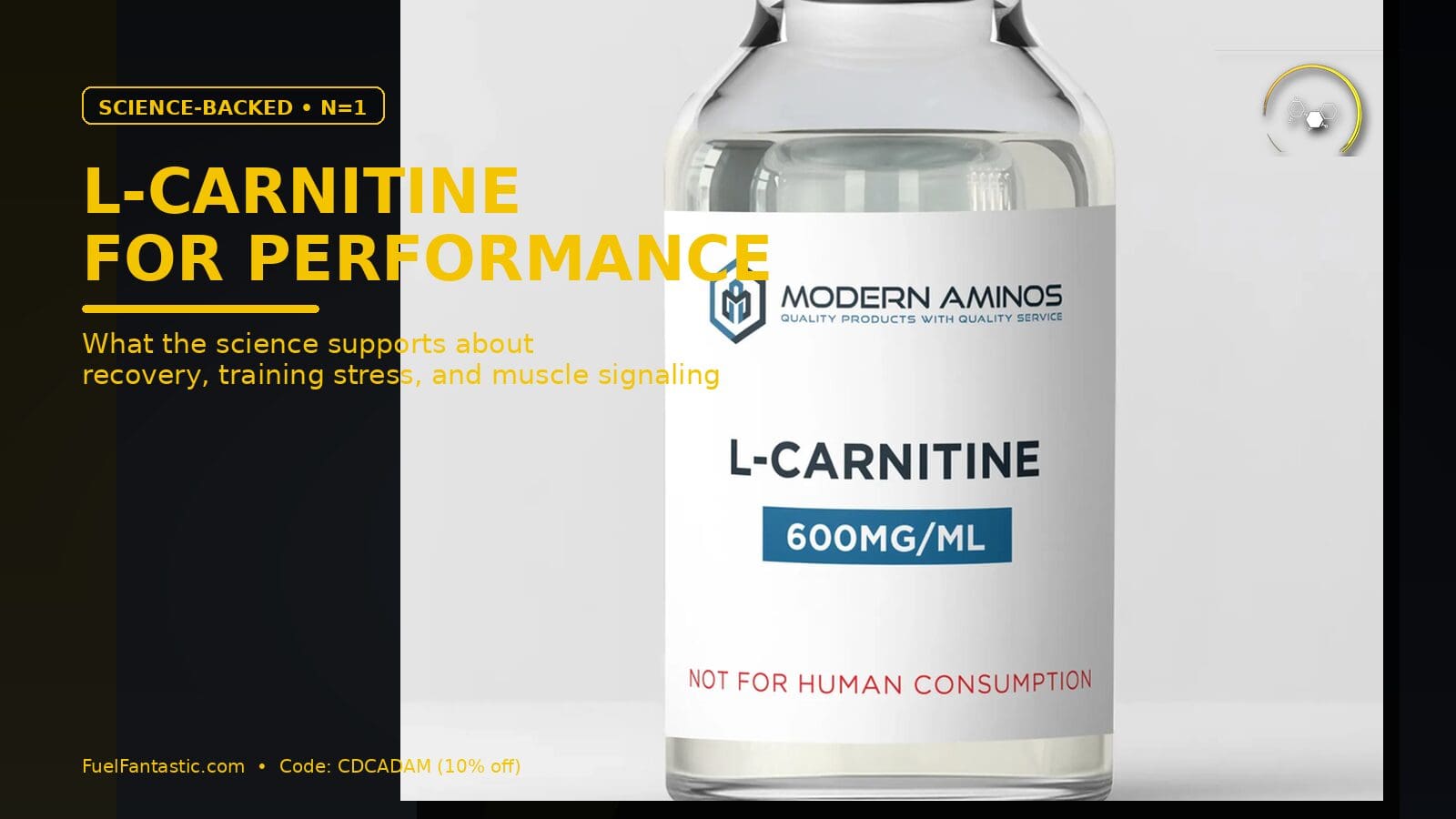
L-Carnitine for Performance: What the science supports about recovery, stress and muscle signaling.
Disclaimer: This article is educational and reflects published research plus my personal N=1 experience. It is not medical advice. Products referenced through partners may be listed for research purposes only. Read the site guidance before proceeding.

L-Carnitine 600 mg/mL
1) What L-carnitine does in the body
L-carnitine supports energy metabolism by helping transport long-chain fatty acids into mitochondria where they can be oxidized for energy production. Carnitine also helps regulate acyl-group handling inside mitochondria, which matters during high demand training where fuel turnover is elevated.
2) Why oral L-carnitine often underwhelms
A common frustration is that oral L-carnitine does not reliably produce noticeable effects for many people. Two reasons show up repeatedly in the literature.
- Supplement absorption is limited: oral supplemental bioavailability is considerably lower than dietary carnitine.
- Muscle uptake is regulated: raising blood carnitine does not automatically mean skeletal muscle carnitine rises quickly.
Another discussion point in the research is the gut microbiome conversion pathway from dietary carnitine to TMAO. This pathway is well documented, while the long-term health meaning remains an active area of debate and context.
3) What the athlete studies actually show
The most consistent performance-adjacent evidence is recovery-focused. Several controlled trials and reviews show signals related to reduced markers associated with exercise stress and muscle damage in certain protocols, rather than a dramatic instant performance boost.
Study highlight: Volek 2002 and recovery after high-rep squats
A classic placebo-controlled study reported that L-carnitine L-tartrate was associated with faster return of malondialdehyde toward baseline after a demanding squat protocol and substantially less MRI-assessed muscle disruption compared with placebo.
Additional human evidence: recovery markers in adults
A randomized study in middle-aged men and women examined L-carnitine L-tartrate and reported improvements in markers tied to performance and recovery from physical exertion in that population.
Big-picture synthesis: 2023 narrative scoping review
A narrative scoping review evaluated L-carnitine supplementation and exercise-induced muscle damage, focusing on postexercise inflammatory and oxidative damage. Results vary by protocol and population, but the most defensible framing remains recovery support in specific contexts.
4) The gym angle: androgen receptor content, what the studies measured, and what online educators get right and wrong
Lifters often reference androgen receptor content because a small set of human studies measured androgen receptor content in muscle biopsies. The key is separating what was measured from what people assume it means.
Androgen receptor changes from training alone
Resistance exercise can increase androgen receptor content, and different squat training volumes can produce different androgen receptor responses in the vastus lateralis. This matters because androgen receptor content is already dynamic from training stress.
The most-cited L-carnitine and androgen receptor study
A randomized, double-blind, placebo-controlled crossover study in resistance-trained men used L-carnitine L-tartrate for 21 days and evaluated androgen receptor content using muscle biopsies around a squat-based resistance exercise session with different postexercise feeding conditions. Findings included increased androgen receptor content with L-carnitine L-tartrate in that study design.
Related studies: recovery stress markers and muscle damage
Additional trials and reviews in this line of research report that L-carnitine L-tartrate can improve certain markers associated with exercise stress, oxidative damage, and recovery following demanding resistance training protocols, although results vary by study design and population.
How to interpret this without overreaching
- This does not prove guaranteed muscle gain or guaranteed hypertrophy outcomes.
- This does not prove you can use less anabolic drugs or improve safety outcomes in enhanced use.
- It is best viewed as a mechanistic observation that may be relevant for muscle signaling and recovery.
Influencer context: More Plates More Dates and Vigorous Steve
More Plates More Dates and Vigorous Steve frequently discuss L-carnitine and androgen receptor content in bodybuilding education content. These sources are not peer-reviewed research, but they shaped the online conversation and often reference the same core studies listed in the references below.
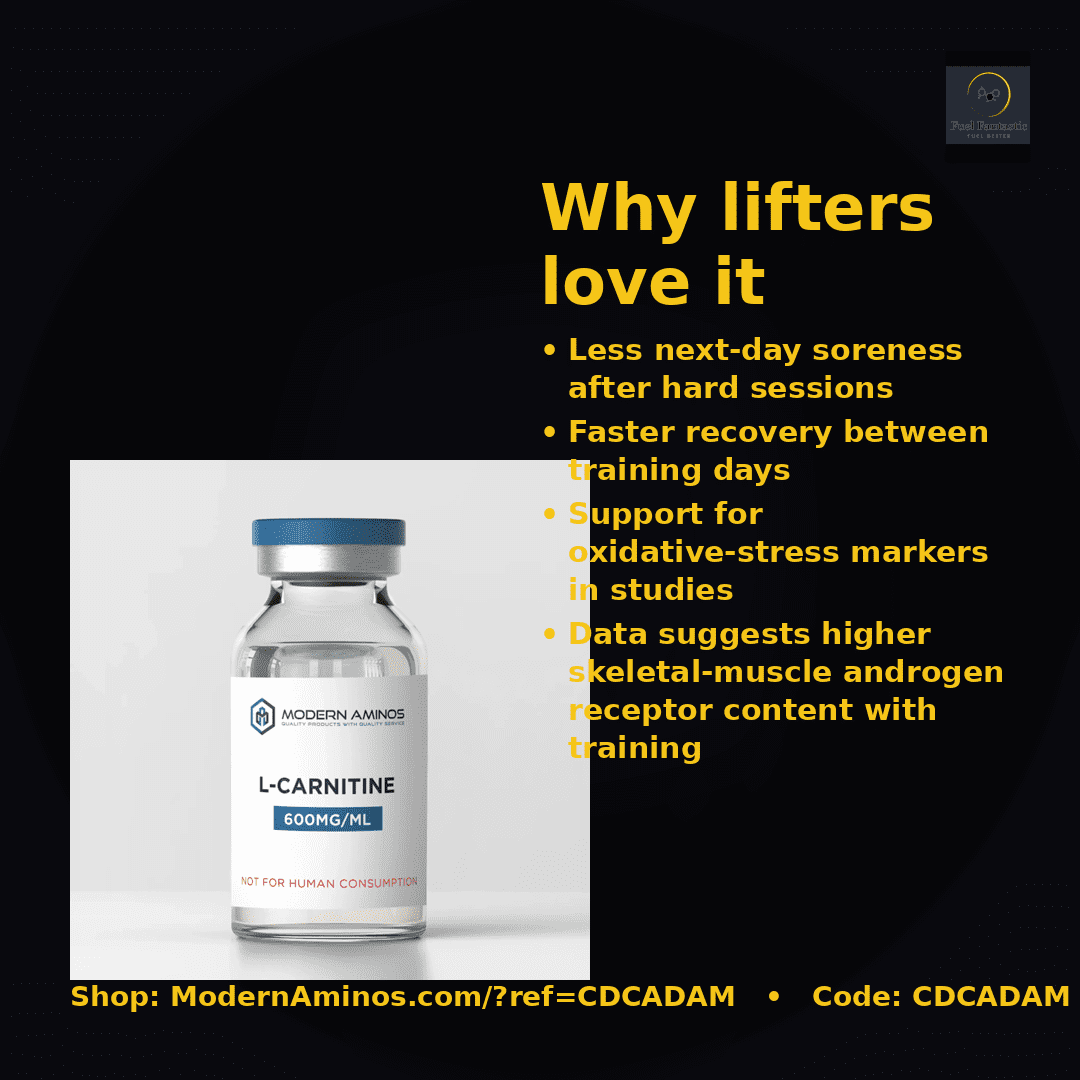
Summary: recovery, soreness, and androgen receptor signaling
5) My N=1 results: what L-carnitine changes for me in real training weeks
This section is my personal experience only. It is not a recommendation or medical advice.
My typical timing and dose
- 400 to 600 mg about 30 to 60 minutes before training on higher-stress days.
What I notice most
- Less soreness after hard training days
- Faster recovery between sessions
- Less lingering inflammation feeling across high-volume weeks
- More consistent training quality because I feel ready sooner
How I keep myself honest
- Next-day soreness level
- How quickly my legs feel normal again
- Whether I can hit another quality session sooner
- Whether weekly fatigue feels lower at the same workload
6) Links: learn more and purchase
Fuel Fantastic guidance page:
https://fuelfantastic.com/peptides-hormones/
Purchase through my Modern Aminos link:
https://modernaminos.com/?ref=CDCADAM
Use code CDCADAM to save 10% at checkout.
References
- NIH Office of Dietary Supplements. Carnitine: Health Professional Fact Sheet.
- Linus Pauling Institute, Oregon State University. L-Carnitine overview and supplement bioavailability range.
- Volek JS et al. L-carnitine L-tartrate supplementation and recovery from high-repetition squat exercise.
- Spiering BA et al. L-carnitine L-tartrate and exercise stress markers following resistance exercise.
- Ho JY et al. L-carnitine L-tartrate and markers of performance and recovery from physical exertion.
- Caballero-García A et al. L-carnitine intake on exercise-induced muscle damage and oxidative stress: narrative scoping review.
- Ratamess NA et al. Androgen receptor content changes after different resistance exercise volumes.
- Kraemer WJ et al. Feeding and L-carnitine effects on androgen receptor content after resistance exercise.
- Koeth RA et al. Intestinal microbiota metabolism of L-carnitine to TMAO.
- Vigorous Steve. Coach Steve’s year-round supplement stack.
- More Plates More Dates. Educational content hub.