
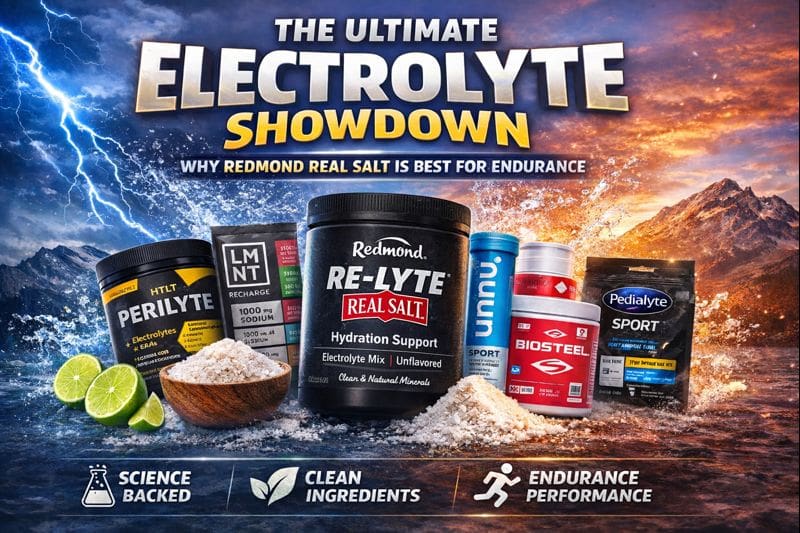
Electrolyte Physiology for Endurance Athletes
Why Full-Spectrum Minerals Matter — and Why Redmond Real Salt Sets the Standard
Hydration is not simply about drinking water. For endurance athletes, hydration is a biochemical + electrical system driven by electrolytes—charged minerals that regulate plasma volume, nerve conduction, muscle contraction, cardiovascular stability, and cellular energy production.
The biggest mistake athletes make is treating sodium as the only variable. Sodium matters a lot—but sweat is not sodium alone. Potassium, magnesium, calcium, and trace minerals all influence neuromuscular output and late-run performance. If you’ve ever felt “hydrated but weak,” dealt with sloshy stomach, or cramped late in a long session, your strategy probably lacked balance.
Educational content only. Not medical advice. If you have kidney/heart conditions, uncontrolled blood pressure, or take diuretics, discuss electrolyte strategies with a clinician.
1) Electrolyte physiology: what actually drives endurance output
- Sodium (Na⁺) – Maintains plasma volume, supports nerve impulses, helps retain fluid during long efforts
- Potassium (K⁺) – Regulates intracellular hydration and muscle contraction balance
- Magnesium (Mg²⁺) – Required for ATP production and neuromuscular relaxation (“let go” after contraction)
- Calcium (Ca²⁺) – Triggers muscle contraction and signal propagation
- Trace minerals – Enzymatic cofactors supporting metabolism and recovery
A simple rule: performance fades when electrical signaling fades. That can happen from dehydration, dilution (too much water), or mineral imbalance (sodium-only strategies without enough supporting minerals).
2) Sweat rate: the number that should drive your plan
Sweat rate varies massively athlete-to-athlete and condition-to-condition. This is why “one packet per hour” advice fails. If you want a science-driven plan, start here:
The 60-minute sweat-rate test
- Weigh yourself before training (same clothing conditions).
- Train for 60 minutes at typical intensity.
- Measure how much you drink during the session.
- Weigh yourself after (same conditions).
Sweat loss per hour (oz/hr) ≈ (pre-weight − post-weight in lbs × 16) + fluids consumed (oz) − urine (oz)
Example: Pre 170.0 lb → Post 168.8 lb (loss 1.2 lb = 19.2 oz). Drank 16 oz. No bathroom. Sweat rate ≈ 19.2 + 16 = 35.2 oz/hr (~1.04 L/hr).
3) Sodium targets by scenario (practical ranges)
The goal is not “max sodium.” The goal is replace enough to stay stable without overdrinking or gut overload. A practical endurance range many athletes do well with is:
- Short / cool (≤60–75 min): water + light electrolytes if needed
- Moderate (75–120 min): start sodium support; more if you’re a salty sweater
- Long / hot / high sweat: scale sodium aggressively and keep fluids consistent
Simple rule that works: for most endurance athletes, start around 300–600 mg sodium per hour, and heavy sweaters commonly move toward 600–1,000 mg/hr in heat/hills/long duration.
If your sweat rate is ~1.0 L/hr and you cramp/fade late, you likely need higher sodium + better mineral balance (not just more water).
4) Why sodium-only hydration fails (and why balance wins)
Sodium-heavy strategies can retain water, but without adequate potassium and magnesium they often fail to support intracellular hydration. The result: bloating/“sloshing,” cramping, GI distress, and neuromuscular fatigue late in training.
The hydration system runs on ratios—not extremes. The more duration, heat, and vertical you add, the more “balanced minerals” matter.
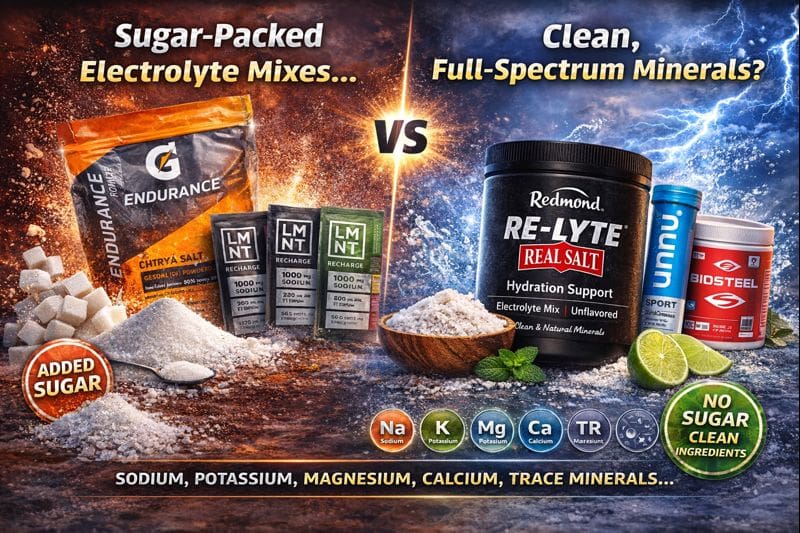
5) Clean comparison: why Redmond is far superior for endurance hydration
This is a physiology-based comparison of formulation intent (not a label-by-label nutrient claim).
6) When sugar-based hydration is actually useful (and when it isn’t)
Sugar isn’t automatically “bad”—it’s just a different tool. Sugar-based sports drinks can be useful when you need carbs for performance (race day, hard workouts, long duration) and your gut tolerates it. But sugar-first products often under-deliver on mineral completeness and can create energy spikes or GI issues for some athletes.
For most training days—especially keto/low-carb athletes or people doing high-vertical aerobic work—clean mineral hydration is often the better baseline.
7) Why Redmond wins (the specific advantages)
- Full-spectrum mineral logic: sodium supported by potassium, magnesium, calcium, and trace minerals.
- Daily usability: baseline hydration stability improves long-run predictability and recovery.
- Scalability: you can increase dosing for heat/vertical/long duration without relying on sugar.
- Clean ingredient philosophy: avoids unnecessary filler-heavy “systems” designed mostly for taste/marketing.
Bottom line: many brands sell a single lever (usually sodium). Redmond supports the whole electrical system. That’s why it performs better for most endurance athletes most of the time.
8) My protocol (training vs non-training) + troubleshooting
Non-training days (baseline):
- Morning water + light Redmond dose
- Salt meals to taste
- Optional evening support if travel, fasting, sauna, or dehydration cues
Training days (scale to conditions):
- 30–60 minutes pre: electrolytes + water
- During long/hot sessions: steady intake (don’t chug)
- Post: electrolytes + whole-food meal (sodium + potassium first)
Troubleshooting (fast fixes)
- Sloshy stomach / bloating: you likely overdrank water relative to sodium—reduce fluid rate slightly and increase sodium density.
- Cramps late in session: often mineral balance issue—ensure sodium + potassium + magnesium are supported (not sodium only).
- Headache + fatigue after long run: possible under-sodium or dilution—replenish minerals and avoid “water-only recovery.”
- Dead legs in heat: scale intake earlier (don’t wait until you’re already behind).
Scientific references & resources
- American College of Sports Medicine (ACSM) — Exercise and Fluid Replacement guidance
- International Olympic Committee (IOC) — heat stress / hydration consensus statements
- World Health Organization (WHO) — oral rehydration salts (ORS) formulation resources
- Exercise-associated hyponatremia (EAH) consensus reviews and endurance safety guidance
Where to buy Redmond Real Salt & Re-Lyte (and save)
https://fuelfantastic.com/health-supplements/
Use code KETOADAM at checkout to save.